

If you’ve spent any time exploring modern fragrance, chances are you’ve come across the word santal. It appears in perfumes, candles, and home fragrance, but what does santal actually smell like?
At its heart, santal is associated with sandalwood: warm, smooth, woody, and softly creamy. Depending on the notes around it, a santal fragrance can also feel earthy, musky, subtly spicy, fresh, or even airy.
It’s a fragrance that makes its presence known without needing to overwhelm a space, and that balance is a big part of its appeal.
First, What Is Santal?
The word santal comes from the French word for sandalwood, a fragrant wood with a long history in perfumery.
But when you see “santal” used in a modern fragrance, it doesn’t necessarily mean you’re smelling sandalwood by itself. Instead, it often describes a broader fragrance style built around sandalwood’s warm, smooth, woody character.
That distinction matters because santal fragrances can move in very different directions depending on what surrounds that woody foundation. Some are dry and earthy. Others are soft and musky. Some introduce spice, florals, amber, or fresher notes.
That’s why two fragrances described as santal can smell remarkably different.
What Does Santal Actually Smell Like?
Think of the warmth of natural wood without the sharpness of freshly cut lumber or the smoke of a campfire.
Santal tends to be softer and smoother.
There’s an earthy quality to it, but sandalwood can also bring a creamy warmth that gives a fragrance depth. Rather than reading as simply “woodsy,” santal often feels polished and understated.
If you typically gravitate toward fragrances that are woody, earthy, warm, or quietly sophisticated, santal is a scent family worth exploring.

Why Doesn’t Santal Smell Like a Typical Wood Fragrance?
“Woody” covers an enormous range in fragrance.
Cedar can feel dry and aromatic. Pine and fir can immediately evoke a forest. Smokier woods can feel dark and rugged.
Santal is different.
Its signature is often smoothness rather than sharpness. The woodiness is there, but it can be softened by creamy, musky, floral, or fresh notes that allow the fragrance to sit comfortably in the background of a space.
That makes santal particularly versatile. It can feel elevated without being formal, earthy without smelling overly outdoorsy, and warm without becoming overly sweet.
Is Santal Masculine or Feminine?
Neither, and that’s part of what makes it so appealing.
Santal sits comfortably in the middle. Its woody character can provide depth, while its smoothness keeps it from feeling harsh or overly cologne-like.
That balance makes santal especially well suited to gender-neutral fragrance and home fragrance, where the goal isn’t necessarily for a room to smell masculine or feminine. It’s simply to make the space feel good.
Why Has Santal Become So Popular?
There is a certain restraint to santal.
It doesn’t have to depend on sugary sweetness, heavy florals, or an immediately recognizable seasonal note. Instead, it creates atmosphere.
A good santal fragrance can make a room feel warmer, calmer, and more intentional without making the fragrance itself the loudest thing in the space.
It also isn’t tied to one particular season. Santal can feel cozy during fall and winter while its woody, earthy character still feels natural during spring and summer.
For people who want a fragrance they can return to throughout the year, that’s a compelling combination.
What Scents Pair Well With Santal?
One of santal’s strengths is how well it works with other fragrance families.
Amber and musk can emphasize its warmth. Florals can bring out its softer side. Spices can add complexity, while fresh notes can keep sandalwood from feeling too heavy.
The result depends less on one individual note and more on balance.
That balance is ultimately what interested us about this fragrance family in the first place.
Our Interpretation: Santal 318

At Clean Slate Botanicals, our interpretation of this fragrance family became Santal 318.
We wanted something grounded and woody, but not heavy. Santal 318 opens with cardamom and crisp cucumber alongside sandalwood. Iris softens the center of the fragrance, while violet and musk create an airy finish.
Top: Cardamom, Cucumber, Sandalwood
Middle: Iris
Base: Violet, Musk
The unexpected freshness of cucumber keeps the sandalwood from feeling dense, while cardamom adds subtle spice. Iris, violet, and musk soften everything around it.
The result is smooth, earthy, and quietly refined—the kind of fragrance that feels just as natural filling a room as it does worn close to the skin.
Experience Santal 318
Scent is difficult to fully understand through words alone. You can describe santal as woody, smooth, warm, and earthy—and all of those descriptions can be accurate—but the balance between those characteristics is what ultimately defines a fragrance.
That’s why Santal 318 isn’t meant to be a copy of someone else’s santal. It’s our own interpretation of the fragrance family.
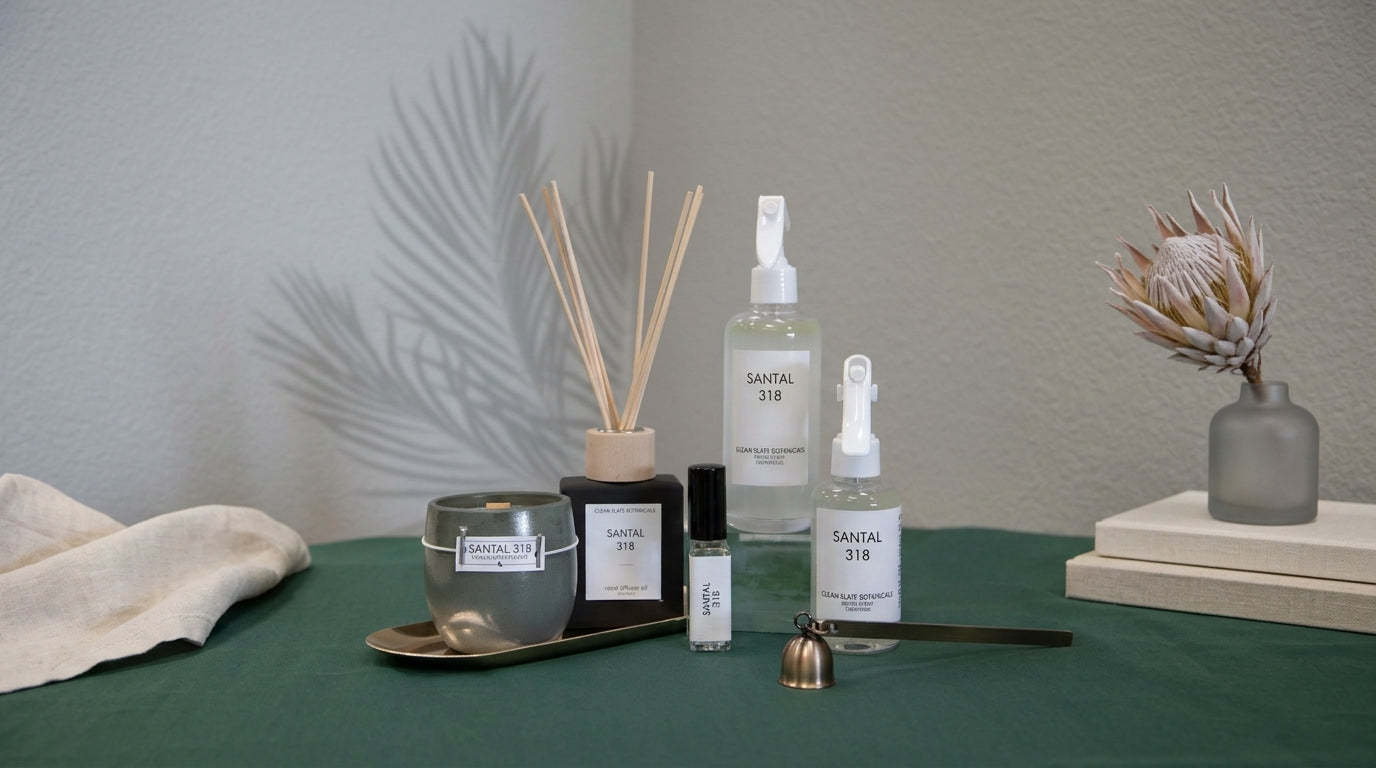
Experience it slowly in our Santal 318 Handmade Concrete Candle, bring it into the everyday with the Santal 318 Room Spray or Reed Diffuser, or wear the fragrance with our Santal 318 Wearable Fragrance.
However you experience it, Santal 318 was created to feel grounded, smooth, and effortlessly elevated.
Explore the Santal 318 Collection →
From our hands to your home.